
Regenerative Therapy
ABI (Ankle-Brachial Index)
A simple pressure ratio that reveals narrowing in the arteries to your legs.
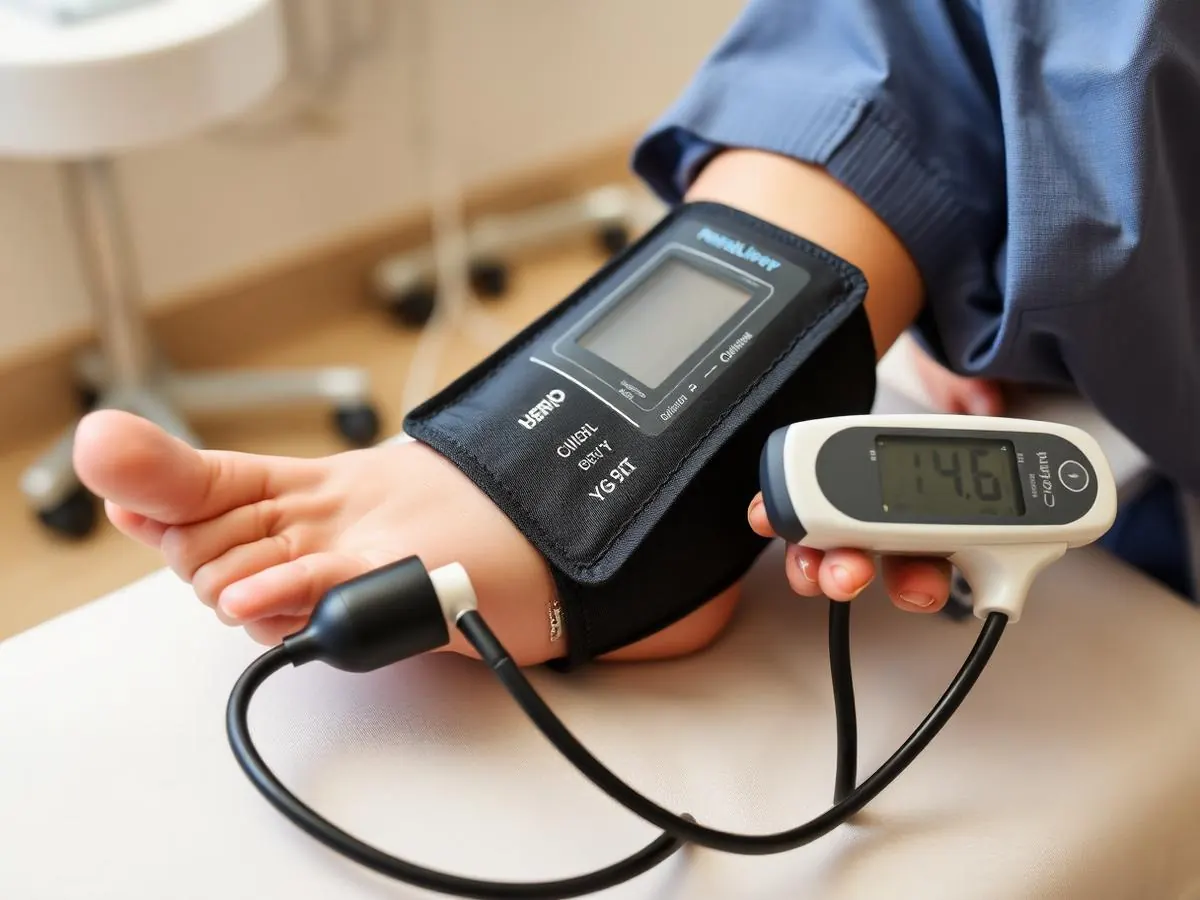
What is ABI (Ankle-Brachial Index)?
Doppler-assisted vascular screening for peripheral arterial disease.
The ankle-brachial index compares the blood pressure at each ankle with the pressure in your arm. In healthy arteries those figures are similar; when the ankle reading falls behind, it points to narrowing somewhere along the arterial path to the leg. The test uses cuffs and a Doppler probe, takes under twenty minutes, and is among the most useful screening tools available for anyone with diabetes, a smoking history, or leg pain that appears on walking.

Key benefits
- 01Detects peripheral arterial narrowing before symptoms become limiting
- 02Painless, needle-free, completed in under twenty minutes
- 03Each leg assessed separately against a reference arm pressure
- 04Reduced results referred directly for a vascular opinion
- 05Easily repeated to monitor risk-factor management over time
How it works
The sequence, from first records to follow-up
- 01
Rest period
You lie flat for five to ten minutes before measurement. Taking readings from someone who has just walked in produces numbers that mean very little.
- 02
Arm pressures
Systolic pressure is measured in both arms, and the higher of the two is used as the reference value.
- 03
Ankle pressures
Cuffs at both ankles are combined with a Doppler probe over the posterior tibial and dorsalis pedis arteries to capture the pressure at each foot.
- 04
Index calculation
Each ankle pressure is divided by the reference arm pressure. The resulting ratio is compared against established thresholds for each leg separately.
- 05
Result discussion
A normal result is reassurance you can act on. A reduced result leads to vascular referral, not to a sales conversation about infusions.
What to expect
Before

Wear clothing that allows access to both ankles. Take your usual medication as prescribed — we are measuring you as you normally are.
During

Fifteen to twenty minutes lying still while cuffs inflate at each limb. Brief tightness during inflation is the only sensation.
After

Nothing at all. You receive the numbers, the interpretation and, where relevant, a referral letter before you leave.
A simple pressure ratio that reveals narrowing in the arteries to your legs.
ABI (Ankle-Brachial Index) — Questions Patients Ask
Why measure ankles against arms?
In healthy arteries, pressure at the ankle is at least as high as at the arm. When the ratio drops, it indicates narrowing somewhere along the arterial path to the leg — which is why the comparison is more informative than either reading alone.
Who should have this done?
Anyone over fifty with diabetes, a smoking history, or high cholesterol, and anyone at any age with leg pain that appears on walking and eases with rest.

Can the result be falsely normal?
Yes. Heavily calcified arteries, common in long-standing diabetes, resist compression and can produce an artificially high index. Where we suspect that, we say so and arrange a different assessment.
Does an abnormal result mean I need surgery?
Usually not. Mild reductions are typically managed with risk-factor control and a supervised walking programme. Only severe findings prompt an urgent vascular opinion.
Reviewed by Bangkok Stem Cell Center Medical Team | Last updated: October 2026
Related protocols
 MSC TherapyMedical team-guided stem cell therapy using mesenchymal cells for joint, immune and whole-body recovery.
 Exosome TherapySignalling-rich exosome protocols, often combined with stem cell therapy, supporting tissue repair, recovery and aesthetics.
 NK & NKT Cell ImmunotherapyNatural killer and NKT cell programs to support immune surveillance, frequently used alongside stem cell protocols.
Next step
Send us your records. We will tell you what is realistic.
A medical team member reads your history before anything is quoted or scheduled. If cellular therapy is unlikely to move your numbers, we say so and point you somewhere more useful.

Mon – Sat
Clinic hours by appointment.